John Anniss
1716 - 1756
Life History
3 February, 1716 |
Born in Harberton, Devon. |
30th November 1739 |
Married Mary Codbear in Harberton, Devon |
1740 |
Birth of son John Anniss in Harberton, Devon. |
1747 |
Birth of daughter Mary Ann Anniss in Harberton, Devon. |
1749 |
Birth of son Henry Anniss in Harberton, Devon. |
1752 |
Birth of son Edward Anniss in Harberton, Devon. |
1755 |
Birth of son James Anniss in Harberton, Devon. |
1755 |
Birth of son Samuel Anniss in Harberton, Devon. |
1756 |
Died in Shaugh Prior, Devon |
Notes
From Ancestry
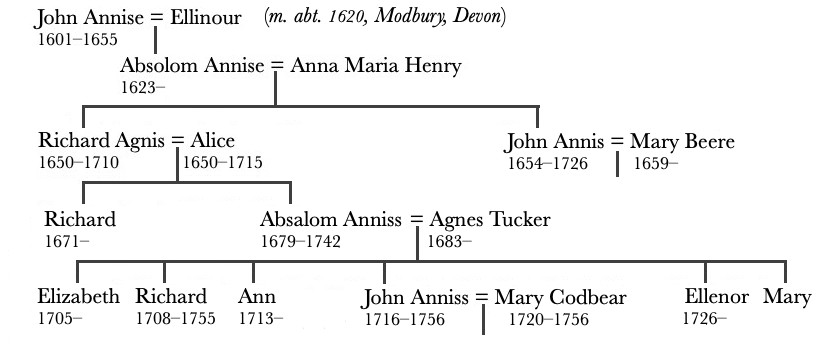
John's Father - Absalom Anniss - born abt. 1679 in Staverton , Devon
married (1) Joan White (1671–1704), 30 August, 1698 in Staverton
married (2) Agnis Tucker (1683– ) in Staverton, Devon.
Buried 2nd Dececember 1742 in Harberton, Devon
John's Siblings: Elizabeth Annis (1705– ), Richard Annis (1708–1755), Ann Agnis (1713– ), John Anniss (1716–1756), Ellenor Annis (1726– ) and Mary Annis ( )
John's Grandparents: Richard Agnis (b, 1650, Staverton – d. 1710) and Alice (1650–1715).
John's Great-grandparents: Absolom Annise (b. 1623 in Modbury, Devon) and Anna Maria Henry.
Añes - Anniss
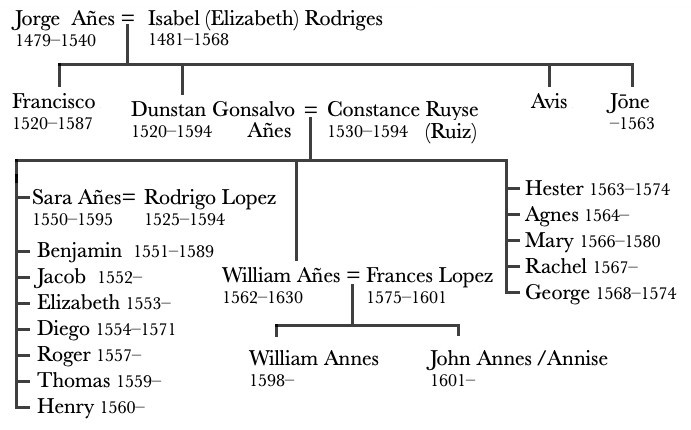
A possible Anniss ancestry:
Dunstan Añes (1520-1594)
Dunstan, also known as Benjamin George (amongst his fellow Jews) and Gonsalvo George (when travelling), was a Marrano, son of the Marrano, Jorge Añes (1479-1540) a sometime citizen of Valladolid and Portugal. Marranos were Jews who became (or pretended to become) Christians when the Inquisition targeted practising Jews in Spain and Portugal at the end of the 15th century.
Dunstan's elder brother Francisco Añes (1520-1587) was a merchant and soldier, and was mayor of Youghal - on the southern coast of Ireland, about 30 miles east of Cork - in 1569, 1576, and 1581. He was described as ‘burgomaster and agent’ of the citizens in 1583. From 1583 to '84, he commanded the English garrison in Youghal and with his nephew William (son of Dunstan) conducted a successful defence of Youghal against Irish rebels. The Earl of Ormond commended them to the Privy Council and said that ‘William Aynes behaved himself like a tall and valiant man’. Another 'William Annyas' (possibly a brother to Jorge Añes) had been mayor of Youghal in 1555.
Dunstan Añes was an immensely rich merchant who traded directly with Lisbon, and was also an intelligence agent for the English government, placing his fleet of ships at the disposal of the English government to carry letters and information to and from British spies as well as to and from his own agents around the world. His sons and son-in-law were also active in the murky world of intelligence. They were part of the spy network that prepared England for the Spanish Armada.
Dunstan had a strong presence in Plymouth. In 1580, acting as financial agent for the Portuguese pretender, Don Antonio, Dunstan helped to organise stores and ships in Plymouth for the Don’s campaign against the Spanish occupation of Portugal. In 1589, he oversaw the expedition of Drake and Norris to restore Don Antonio to his throne. (Both expeditions were failures).
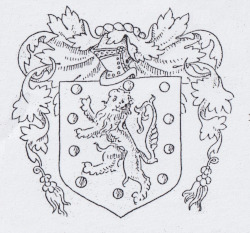 Dunstan became a 'Freeman of the Grocers’ Company' in 1557 and was appointed ‘Purveyor and Merchant for the Queen's Grocery’. Queen Elizabeth granted him the coat of arms on the right.
Dunstan died in 1594, just prior to the execution of his son-in-law, Dr Rodrigo Lopez, the Queen's physician.
Dunstan's daughter, Sarah Anes (1550-1595), married Doctor Rodrigo Lopez in 1567. They had seven children.
Rodrigo Lopez (1525-1594), another Marrano, a trader and English Agent, was also a renowned doctor who became the first physician of Queen Elizabeth I. He was executed by being hung drawn and quartered at Tyburn in 1594, convicted on dubious evidence in a plot to poison Queen Elizabeth. He had made an enemy of Devereux, Earl of Essex. Few people that knew the doctor believed the story. Queen managed to put off what should have been an instant execution for four years. Rodrigo's accusers forced her hand by inciting mob hatred and violence against the 'Jewish poisoners'. Playwrights of the time pandered to the mob and a number of plays appear with evil Jewish characters, one of them 'The Merchant of Venice'.
It is likely that around the time of the trial members of the Lopez, Anes and other Marrano families found it expedient to move away from London and find refuge with relations or in houses in Bristol, Plymouth and other ports where they had businesses. Certainly the name Anes disappears from records. Perhaps after a while the family, in different locations around the world settle on Annis or Anniss as the new family name.
"There is some reason to suppose that some Marranos settled in the South-West in the sixteenth century, possibly in Exeter, but they certainly had some connections with Plymouth where the London Marranos stationed agents. These agents served a dual purpose. Their primary function was to promote trade for the Marrano mercantile houses which they represented. A secondary function was to inform Marranos who had fled from Spain and Portugal and who wished to practise Judaism openly again whether or not it was safe to proceed to the Low Countries to do so. [Hyamson, Sephardim of England, p. 4, and Roth, Jews in England, p. 137.]
Dunstan and Constance Ruiz had eight sons and six daughters. The son who might be our Anniss ancester is the seventh son, William (1562-1630) alias Ylierm Anes, who married Francis Lopez in Plymouth and had a son called John, born in 1601, in London. Les Anniss of Cardiff (courtesy of Clare Neville-Dove) presented a good case for William's son John being the John Annise who married Eleanor at Modbury, and had a son called Absalom, born 27th of July 1623 in Modbury.